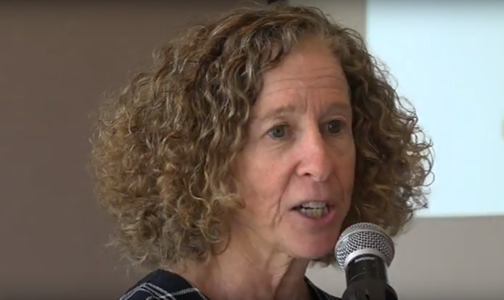
Mimi Willard on the Charlie Siler Show MMWD Rate Hike May 22

Mimi Willard and Paul Premo of the Coalition of Sensible Taxpapers are joined by Charlie Duggan of the Marin Municipal Water District to discuss the pros and cons of a proposed rate increase for Marin County customers.

COST Threatens Lawsuit Over MMWD Rate Hike in MarinIJ

A taxpayer group put the Marin Municipal Water District on notice Thursday, saying it faces “legal peril” if it approves a proposed water rate and fee hike next week.

“It effectively notifies the water district of multiple potential violations of the law if they approve the new fee and rate hike as proposed at the rate hearing on May 28,” Mimi Willard, founder and president of the Coalition of Sensible Taxpayers, or COST, wrote in an email. “I can’t comment on what will be our next step if MMWD proceeds. What I can say is that MMWD can neutralize many of the legal issues if they don’t approve the rate/fee as proposed.”

The water district board of directors is set to vote Tuesday to approve a four-year water rate and fee hike, which includes a new “capital maintenance fee” on customers’ yearly property tax bills. More here

COST Demands MMWD Cease Brown Act Violations

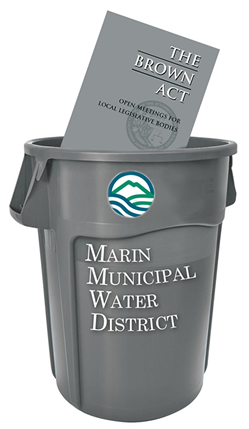
CO$T alleges ongoing MMWD Brown Act Violations, Sends Cease and Desist Demands.

On March 22 and May 15, 2019, CO$T sent MMWD cease and desist letters demanding compliance with the Ralph M. Brown Act. The Brown Act guarantees the public’s right to participate in local public legislative meetings. It requires advance notice, agenda posting, and public access standards. CO$T demands that MMWD cease specific Brown Act violations and desist from future ones.

CO$T’s initial complaint was prompted by violations that occurred in the MMWD Board of Directors’ development of a rate hike and new fee proposal.CO$T alleges such violations impeded the public’s right to know about, and participate in, the board’s consideration of the rate and fee plan as it was being developed. Of particular concern were meetings, posted on the Committee calendar, in which a majority of the board participated and guided staff on the design of a rate / fee proposal and the ratepayer notice required by Proposition 218. Further, the agendas for these meetings did not clearly state that documents concerning proposed rate increases and new fees, or a Proposition 218 notice, would be discussed.

CO$T’s latest complaint alleges improper use of Special Meetings. The Brown Act requires 72 hour public notice and agenda posting prior to Board meetings. Special meetings require only 24 hour notice. What were regularly scheduled meetings posted on the Committee calendar but attended by a board majority — the subject or our initial Brown Act complaint — are now listed as Special Board meetings. This potentially subverts the 72 hour notice requirement while attempting to legitimize Board meetings at 9:30AM on weekdays when the public can’t attend.

CO$T has referred our information about alleged Brown Act violations to the Mann County District Attorney’s Office, which we believe has independently investigated related concerns.

CO$T’s attorney’s letters to MMWD have also asked for more full public access and transparency to its Board and Committee meetings. These include videotaping and promptly posting all board and committee meetings as is done at all similarly sized Marin agencies; and making available 72 hours in advance final staff reports and PowerPoint presentations used at Board and Committee meetings.

PLEASE CONSIDER MAKING A DONATION TO CO$T to help defray our legal expenses incurred in defending Marin residents’ right to know about and participate our local government’s activities. Without your help, we cannot do what we do. Donate via PayPal at CO$TMarin.org or via check mailed to P.O. Box 253, Kentfield, CA 94914

About CO$T: The Coalition of Sensible Taxpayers advocates on behalf of the rights and interests of Marin taxpayers and ratepayers. CO$T is a nonpartisan, tax-exempt organization. CO$T’s 501(c)4 is recognized by the IRS as a social welfare organization. The CO$T Foundation, a 501(c)3, conducts educational, research, and other qualified activities funded with tax-deductible donations.

MMWD’s meter-based fee plan unfair to ratepayers- Marin Voice

The district doggedly presses forward with a proposed series of rate increases and a novel infrastructure investment fee that hasn’t been justified, is unfairly distributed among ratepayers and financially incentivizes behavior that increases wildfire risk.

It also hasn’t warned ratepayers of further steep increases in what they will pay.

MMWD’s plan includes water bill rate hikes and adds a sizable capital maintenance fee based entirely on meter size (as opposed to usage). Both increase up to 4% annually for four years. The capital fee starts at $163 for those with 5/8-inch residential meters; $409 for those with 1-inch meters; and $817 for those with 1.5-inch meters. Many low water users’ total MMWD payments double within five years.

The unprecedented $16.5 million infrastructure fee falls disproportionately on homeowners. Homeowners consume 68% of MMWD’s water but will pay about 80% of the capital maintenance fee.

The proposed scheme became even more unfair as MMWD’s board tried to placate one outraged ratepayer group after another. Just prior to mailing its rate notice, MMWD added language exempting private fire lines from paying the capital maintenance fee. These large-diameter pipes serve big buildings’ interior sprinklers. The private fire line exemption appeared after school districts expressed alarm that MMWD’s proposal could force teacher cutbacks.

MMWD claims it never intended to charge private fire line customers a capital fee because sprinklers are rarely used. That caused residential customers with sprinklers to cry foul. Like private fire line customers, they rarely use sprinklers but must have extra incoming water capacity, i.e., 1- to 1.5-inch meters, incurring a high capital maintenance fee.

More Here:

MarinIJ Link

How To Protest the MMWD Rate Hike

MMWD RATE HIKE PROTEST FORM

MUST BE RECEIVED

PRIOR TO THE CLOSE OF THE MAY 28, 2019 MMWD PUBLIC HEARING

Click Here for the CO$T Protest Form

Click Here for the official MMWD Instructions to file a protest.

MMWD Rate Increase Meeting March 19

MMWD Meeting on Rate Increase March 19, 2019

Marin Municipal Water District Board meeting on rate increase of March 19, 2019. Posted by CO$T Marin.

MMWD Start Over with a Plan That’s Fair & Not on Property Tax Bills

MMWD’s upcoming PR visits to City Councils are a chance for you and your council to object to the Reverse Robin Hood funding scheme: its proposed capital maintenance fee (CMF). Speak up during public comment at your council meeting. Email your Council members and urge them to represent your concerns.

MMWD should PAUSE THE PROCESS and develop a fairer scheme that has wide community support. That’s what the Marin IJ Editorial board advocates.

Marin Municipal Water district proposes to collect a sizable new fee for infrastructure projects. It starts at $16.5 million annually and will grow very substantially. While the project list may or may not be worthy, the funding scheme is not.

The smallest customers (homeowners) will pay disproportionately. This is because the fee (1)is based on meter size rather than water usage and (2)exempts private fire lines, which are very large diameter meters serving the biggest customers (e.g., malls, office buildings, and apartment complexes). Renters who are directly billed by MMWD (typically those who rent an entire house) are also exempt.

The CMF will go on property tax bills of homeowners and businesses; tax exempt entities will be directly invoiced.

Most homeowners’ CMF will start at $163 (5/8th inch meter) or $409 (1″ meter); some homeowners will pay $817 (1.5″ meter). This is the tip of the iceberg. The fee initially will escalate up to 4% per year. PLUS, MMWD has openly discussed the “need” to bump it up much more substantially, doubling or trebling it to accommodate their big plans. They can boil the frog quickly. You don’t get a direct vote.

MMWD’s visit to your city council is an important chance to be heard, and for your Council to weigh in. Ask your City Council to support you by telling MMWD to:

– Declare a time out to reconsider options for a more equitable and affordable fee to fund infrastructure projects.

– Don’t put a CMF on property tax bills. Nothing good results. Many ratepayers won’t notice how much their total payments to MMWD went up. But many WILL see that their taxes have gotten bigger yet again. The risk: MMWD crowds out other vital services like schools and parks, as overburdened taxpayers reject future tax measures.

– Collect any CMF via water bills and make it fair. Spread infrastructure costs equitably across ratepayers by tying any CMF to water usage. That can be structured to provide a predictable flow of capital to MMWD, per CO$T Director Paul Premo’s Better Plan.

– Don’t move abruptly away from debt financing to “Pay as You Go.” That results in unnecessarily high costs to current ratepayers. With rates now at historically low levels, MMWD should issue debt every few years to fund capital projects. That would lower the financial burden on today’s ratepayers and more fairly spread the cost of long-lived infrastructure over generations of Marin water users.

– Commit not to jump up the CMF during the initial 10 years. The announced 4% per year “inflation” increases are more than enough. That compounds to 48% over the decade. A doubling or trebling of the CMF — which MMWD is building the case to ultimately do — would be a very onerous for homeowners, who don’t get to vote on the fee.

Return your rate protest form! You will receive soon an official rate hearing notice from MMWD. It is a legally required notification of the proposed CMF PLUS a series of back to back 4% annual hikes in your regular water bill rates. To stop these fee hikes, a majority of ratepayers must return the rate protest form that’s in that mailer. While 50%+ is an insurmountably high bar, a large number of protest forms should alter the final outcome, if MMWD Directors care about your concerns.

Upcoming MMWD appearances open to public comment and Q&A:

Corte Madera Council – Tues April 2, 6:30PM
Fairfax Council – Weds April 3, 7PM
Ross Council – Thurs April 4, 6PM
Belvedere Council – Mon April 8, 6:30PM
Mill Valley Council – Mon April 15, 6:30PM
San Rafael Council – Mon April 15, 7PM
Sausalito Council – Tues April 16 or 30
Tiburon Council – TBD
Marin Coalition lunch – Weds May 1, 11:30AM

In addition, there are these MMWD hosted events:

Mill Valley Community Workshop – Thurs Apr 25, 5-8PM – Mill Valley Community Center, 180 Camino Alto

San Rafael Community Workshop – Weds May 15, 5-8PM – Albert Boro Community Center, 50 Canal Street

RATE HEARING (when MMWD board votes to approve new fees and rates):
Tues May 28, 7:30PM – 220 Nellen Ave, Corte Madera

Tell MMWD: Slow Down. Come Up with a Better Plan!

Tell MMWD: PAUSE! Proposed Big Fee Flawed by Rushed Process

Marin Municipal Water District plans to put a big, new, annual fee on your next tax bill, AND, send a HUGE invoice to your public school district and municipality. Despite a stated 10 year term, the District plans that the proposed Capital Maintenance Fee will be ongoing for decades, with annual escalators. They’re already contemplating the “need” to reset it to a substantially higher level one or more times in coming years. Other utility-like agencies (e.g., water and sewer) throughout the Bay Area are watching MMWD’s bold move with an eye to following suit. If you don’t live in MMWD’s territory, don’t think these unfolding developments won’t affect you.

You don’t get a direct vote on Water Fees. At its 7:30 PM Tuesday March 5 board meeting (220 Nellen Ave, Corte Madera), Directors will vote to mail a proposition 218 notice informing ratepayers of the new fee. After a required 45 day waiting period, MMWD’s board will likely ratify putting the new fee on ratepayers’ next tax bill (and directly invoicing schools and cities that don’t get a tax bill). That final hearing and vote is planned for May 14.

Speak up now! Before the train leaves the station.

Putting on the tax bill a big new water fee that’s not tied to water use is unfair to those who have conserved and places further pressure on homeowners struggling to stay in their homes. The proposed new fee starts at $163.50 yearly for most homeowners, but some will pay much more, including one-fifth of homeowners whose initial tab will be $408.74. The fee is slated to rise annually, tied to the (usually well-above CPI) Bay Area Construction Cost Inflation Index.

Very troubling impact on schools and municipalities. Tam Union High School District, which has been forced to cut teaching positions owing to financial woes, says it will receive a $160,000 invoice in year 1 (the cost equivalent of more than one full teacher). Our sources say San Rafael School district’s bill will exceed $300,000 (perhaps substantially).

To offset the unexpected levy, schools may have to further reduce teacher count, and cities cut basic services. Or, they might seek approval for new taxes from voters. At some point taxpayers max out, rejecting higher tax measures on the ballot. MMWD, which doesn’t need voter approval for its fee and rate hikes, may crowd out other important public priorities.

Tell MMWD’s board to PAUSE and consult with the community on a better plan. Speak up at MMWD’s board meeting, 7:30PM, Tuesday March 5, 220 Nellen Avenue, Corte Madera. If you can’t make it, email your concerns to the board (and copy us at CoalitionTaxpayers@gmail.com):

Jack Gibson yojcg@msn.com
Armando Quintero aquintero@marinwater.org
Larry Bragman lbragman@marinwater.org
CynthiaKoehler ckoehler@marinwater.org
Larry Russell lrussell@marinwater.org

We need your help. To volunteer for the MMWD project, contact us and we’ll be in touch. To contribute money to our effort, click here­.

‘****************************************************************************

What’s Wrong with MMWD’s Fee and Process? Keep reading!

Too much hurry, too little consultation. MMWD is in a big hurry to get the new fee in place for before July 1, the start of the District’s new fiscal year and also the new tax bill year.

They argue that a big step up in ratepayer dollars is necessary to maintain ageing infrastructure. Late in the process, a modest amount of the proposed fee was also earmarked for fire prevention projects.

Regrettably, the District, while working internally on this proposed fee for some time, largely failed to consult the community regarding the project priorities or the fee’s magnitude, design, and distribution among ratepayers. School districts and city councils were in the dark, as were homeowners who will bear most of the brunt. A Citizens Advisory Panel wasn’t convened until late December 2018, leaving no time to produce a thorough report. MMWD Customers who will pay the bills were not formally represented on the panel. Residents who would prioritize fire prevention in the watershed — some of whom might be willing to pay even more for that security — weren’t given a chance to weigh in. The result is a proposal that isn’t ready for prime time. Tell MMWD to slow down and get this right.

New fee hits homeowners hard, and especially water savers. The capital maintenance fee — which is based on the size (volume) of each customer’s water meter, and without any recognition of individual customers’ water usage — falls heaviest on small water users. Small meter size MMWD customers (most of which are single family home occupants) will pay 78% of the fee while currently consuming only 58% of the District’s water output. The fee isn’t tied to consumption at all. Water conservers will see the biggest annual percentage increase in the amount they pay to the water district. Ratepayers should demand that some or all of the new fee be tied to water consumption.

New fee on the tax bill isn’t transparent. MMWD hasn’t provided any logical reason for not putting the fee on water bills, where we can see how much the invoice goes up. Marin County charges MMWD (=us) to bill via the tax roll. Ratepayers should demand that any new fee be on the water bill.

Financial need and alternatives haven’t been publicly aired. MMWD says the sharp jump in its push for more money ties largely to a planned move entirely away from bonds (which spread financing costs over time) to having current customers pay entirely for replacing long-lived assets and updating systems. Independent financial experts (many live in our community) weren’t consulted on this approach. It’s also worth evaluating to what extent MMWD needs more money because of rising benefits and expenses. MMWD’s total compensation (including benefits) now averages nearly $200,000 annually per full-time employee. How much could be saved by renegotiating labor contracts (including rich healthcare insurance benefits for retirees); putting in place caps on starting salaries of new hires; and ending the unusual practice of very part time board members accepting fully paid, tax-free healthcare insurance? Does the district have a good plan to “ring-fence” the new operating fees to ensure they aren’t subsidizing rising operating costs? Ratepayers should demand MMWD tap financially savvy community members to vet the district’s entire capital fee plan.

Process marred by ongoing poor transparency. MMWD has repeatedly rebuffed, without good reason, constituents’ requests that the District video and post board meetings; other similarly sized Marin jurisdictions do so. Staff reports and PowerPoint presentations are often unavailable to the public prior to those meetings (or not even posted online after the fact). Public complaints about these shortcomings have not produced any change. Meetings of standing committees (e.g., finance, communications, operations, etc.) are similarly deficient on transparency. Ratepayers must demand improved transparency: MMWD should videotape all board and committee meetings with closed captions for the hearing impaired. They should post 72 hours in advance all staff reports and presentation materials.

TAM Needlessly Threatens 2019 Crossing Guard Cuts if Voters Reject AA

Transportation Authority of Marin’s proposed ½ cent sales tax renewal has attracted considerable opposition owing to its 30 year term. With rapidly evolving technological and societal changes, that’s much further into the future than any congestion management agency can predict.

If TAM gets a 30 year renewal they won’t have to deal with us pesky voters again for a generation. Kids now in the 3rd grade will be nearing 40 before they get to vote on TAM’s priorities.

Those same kids’ safety is now held hostage in a get out the vote power play.

A major part of TAM’s effort to secure support for AA centers around its claims that it will have to fire at the end of this year 22 of the current 88 school crossing guards if AA doesn’t pass. TAM’s reason: a 25% rise in the cost of its crossing guard contract. What’s with that?

Now the pro-AA Keep Marin Moving campaign makes the fabricated threat that the crossing guard program would be eliminated altogether if AA isn’t passed. The Keep Marin Moving campaign is mostly funded by the companies that feed at TAM’s trough: those providing labor, engineering, construction, and consulting for major public infrastructure projects.

Here’s what they chose to post at the very top of their YES on AA Keep Marin Moving Facebook page:

Marin kids are relying on YOU to vote YES on AA! Measure AA will expand Safe Routes to Schools and will save Marin’s Crossing Guard Program from elimination. Support Marin kids – support Measure AA!

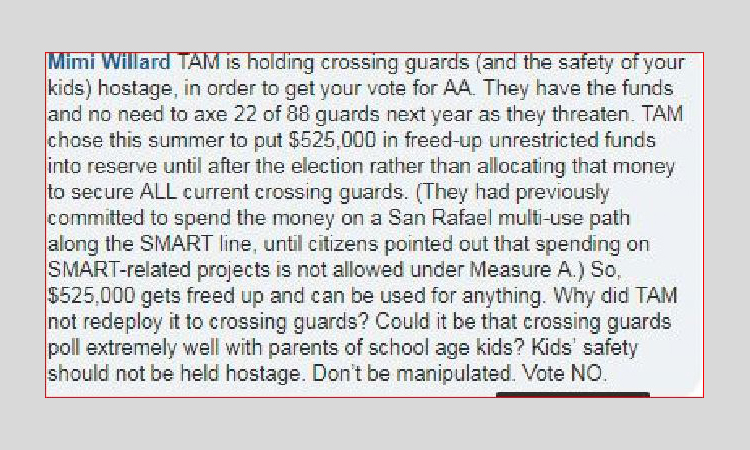
I posted on their Facebook page the reply below.

TAM minutes and emails substantiate every one of the statements in my above post.

My factually accurate post was promptly removed by the Keep Marin Moving Facebook page administrator. Three times. The same thing happened to several other people who posted on the pro-AA Facebook page. All of them were then blocked from viewing the page.I was not immediately blocked so was able to get before and after screenshots of my disappearing posts.

Who the heck hovers over an obscure pro-AA website instantly deleting inconvenient facts?

Folks who have a lot of money at stake.

Parties who have or seek contracts with TAM have contributed over two-thirds of the nearly $100,000 raised for the pro-AA campaign. By the time the campaign’s final financials are disclosed, that figure will certainly be higher, maybe much higher.

In fact, $7,500 so far comes from All City Management Services, the Santa Fe Springs based crossing guard company.

TAM has six years remaining in its current ½ cent congestion relief sales tax.

Don’t be manipulated by the supposed crossing guard crisis. TAM can allocate unrestricted funds in hand to sustain the full number of crossing guards for another year or two. During that time, TAM should come up with a 10 year sales tax measure that’s a coherent plan rather than a wish list designed to please (or terrify) each special interest and jurisdiction.

Vote NO on thirty-year AA.

COST Says Yes on Measure J

The Coalition of Sensible Taxpayers Urges
Vote YES on Measure J

Tamalpais Union High School District
$149 Annual 4-Year Supplemental Parcel Tax

The Coalition of Sensible Taxpayers encourages voting YES on Measure J, a supplemental $149 annual parcel tax. Measure J would expire in June 30, 2022, simultaneously with the existing $294 annual parcel tax. Both escalate 3% annually. Funds support southern Marin high schools Redwood, Tamalpais, Drake, Tamiscal, and San Andreas.

While it’s unusual for a taxpayer group to endorse a parcel tax, CO$T’s board believes the reasons for doing so in this instance are compelling… and meet many of our Sensible Tax criteria:


Urgent need. Tam Union is operating under a Marin County Office of Education warning of potential insolvency resulting from operating deficits and falling reserves. Without Measure J, Tam Union will have to cut up to an additional $5 million in annual expenses (beyond significant cuts that are already underway).

Modest levy. The $149 supplemental amount is not large by Marin standards. The tax won’t solve Tam Union’s financial woes. It will provide breathing room to make less Draconian cuts to school programs.

Short leash. Both the existing and proposed supplemental tax expire in 4 years. We expect the district to put a renewal measure before voters in 2020 (leaving time for a second try if voters say No). By then, we’ll know a lot more about the how well new district leadership is balancing costs, educational priorities, and the need to rebuild reserves.

New management. The prior Superintendent and Chief Financial Officer have departed and been replaced via the promotion of two well-respected district veterans. We give them a preliminary vote of confidence. New leadership should have a chance to reset spending priorities without the extra burden of budget cuts even sharper than those already on tap.

New board. Three of the five incumbent board members are retiring, leaving three openings to be filled via the November ballot (there are four candidates). Two current board members (whose terms expire in two years) are staying, providing some continuity and knowledge. Let’s see what the new board, which may include some newcomers with financial acumen, can deliver.

Streamlining. New initiatives are already underway: Top management positions consolidated; more shared services; supplies cut; reduced cafeteria offerings; cancelled additional portable classrooms. Next moves being studied.

CFAC. Tam District seems receptive to our recommendation of forming a small Community Financial Advisory Committee of financially astute district residents to explore best practices and strategies to improve the district’s long-term financial health. CO$T believes it’s important to get advice from a team of independent experts.

Transparent. Tam Union’s online parcel tax information provides fair disclosure of the factors contributing to the district’s financial challenges, including rising enrollment and state-mandated pension contributions. Tam Union consistently does a superior job of keeping the broader community informed and involved. All board meetings are video taped and posted to the district website. On-line board minutes and agendas are complete, including all relevant staff reports, presentations, and documents.

Inclusive election. Tam Union intentionally chose a general election for Measure J. This ensures that the largest number of voters will weigh in on the parcel tax (rather than a special all-mail off-cycle ballot in which district parents and tax-exempt seniors comprise a large share of the ballots cast).

CO$T has some reservations about endorsing Measure J:

Regressive. Parcel taxes hurt small condo and home owners, who pay the same amount as large apartment complexes and malls. The increasing number and amount of parcel taxes (and bond measures tied to property value) are a significant factor in Marin becoming unaffordable to existing home owners. CO$T continues to urge that school districts work with legal advisers and state legislators to clarify schools’ ability to use fairer, alternative parcel taxes (based on per square foot or per dwelling unit).

Insolvency risk. The district plans to use Measure J supplemental parcel tax revenues to avert further cuts in academic programs, on-campus services, and perhaps employee benefits. We would like to see a portion of the $149 supplemental tax directed each year to gradually rebuilding badly depleted reserves. Tam Union is very vulnerable to becoming truly insolvent during the next slowdown of the economy and real estate property taxes. It’s prudent to start putting money back into reserves now.

Disappoint some CO$T supporters. It’s unusual for a voter-taxpayer group to endorse a tax. That said, we never pledged to oppose every tax. We believe in Sensible taxes that are truly necessary to support vital services. We’ve laid out the criteria and believe that four short years of Measure J is a reasonable compromise within that framework.


COST says NO on TAM Tax Measure AA

Argument Against Measure AA (TAM Sales Tax Renewal)

Voters should reject Measure AA, a thirty-year renewal of the 0.5% county-wide sales tax whose revenues go to the Transportation Authority of Marin.

Thirty years is way too long. The Transportation Authority of Marin doesn’t have a coherent thirty year congestion relief plan.

It has a “Christmas list” of possible near-term projects intended to woo votes. Many of these would be completed in a handful of years. It’s impossible to know how exactly the money will be spent over the subsequent 20-25 years. Why trust TAM will make wise choices as technology, transportation modalities, funding sources and politics evolve?

TAM has ample time to develop a shorter, better, sales tax measure. The current ½ cent tax continues until 2025. What’s the hurry?

TAM should come back to voters with a 10 year sales tax measure and a detailed expenditure plan. It should specify each project’s funding allocation, impact on traffic congestion, and number of people benefiting.

TAM’s twelve not-directly-elected commissioners fund some pet projects ahead of ones citizens want most, like Yellow School Buses, crossing guards, electric vehicle infrastructure, and Adaptive Signal Control Technology (smart traffic lights). TAM now threatens to cut crossing guards or freeze school transit expansion unless we approve Measure AA.

Whatever your politics, Measure AA is bad policy. Learn more at CostMarin.org (sensible taxpayer-voter perspective) and Transdef.org (environmentalist perspective).

Voter-taxpayers deserve a comprehensive transportation vision, more transparency, and a regular opportunity to weigh in.

VOTE NO


Rebuttal to argument in favor of AA

How’s TAM’s existing congestion relief “program” working out for you?

Has your commute time on 101 fallen or neighborhood traffic reduced?

Have your potholes been filled and roads repaired?

Has it gotten easier to travel around Marin by bus?

After 14 years of paying TAM’s current ½ cent “congestion relief” sales tax, voters have little to applaud.

Now TAM wants free rein until 2049! Avoiding future voter scrutiny is the only reason for a tax measure this long.   They can’t plan that far out.
  
Don’t be misled by proponents’ promises. They’re nothing but a list of projects that poll well. There’s no coherent congestion relief vision, nor sufficient money to deliver all the bright shiny objects promised to voters.
 
Measure AA proposes Marin taxpayers provide key funding for a direct connector between Hwy 101 and I-580 – helping East Bay commuters.  How much more will we pay when costs overrun the purported $135 million?  Will the connector ever be built?   
 
Don’t believe TAM’s fear-mongering: There’s no revenue loss or delay for transportation projects if Measure AA fails this November.   The current tax doesn’t expire until 2025, over six years from now.   What’s the hurry?  Is it that TAM wants to get ahead of the next transportation sales tax on the ballot — a renewal measure for SMART?
 
Voters risk NOTHING by sending Measure AA back to the drawing boards. 

TAM must develop a detailed 10 year vision and expenditure plan.

Marin needs traffic relief. Measure AA doesn’t provide it. 

VOTE NO ON MEASURE AA


TELL SUPERVISORS: REBUFF MAPE’S DEMANDS. REPRESENT US!

The Marin Association of Public Employees (MAPE)* is going on strike to force Marin’s Board of Supervisors to give them an 11% pay raise! Their demands are excessive and lack accountability.

Our supervisors vote on any contract. Tell them to reject MAPE’s demands. And insist that Supervisors who have repeatedly accepted campaign money from MAPE — Supervisors Katie Rice and Kate Sears — recuse themselves from MAPE-related contract votes and negotiations.

Enough is Enough!

.
CLICK HERE TO SIGN THE PETITION

Please consider the following reasons for supporting this petition:

Marin’s public employees are currently among the highest compensated employees in the entire U.S. (top 1%), even above (7.8% higher) San Francisco, where the cost of living is even greater than in Marin.
MAPE’s demanded pay raise is not performance based.
MAPE’s demanded pay raise is not need based.
The average Marin public employee makes $126,000 per year in total salary and pension and healthcare benefits. The average working adult in Marin makes $64,210.
MAPE salaries impact the County’s future pension and benefits liabilities. The County’s unfunded pension liabilities are already between $700 million and $1.2 billion (estimates vary).
The only way the County will be able to meet the additional financial obligation resulting from MAPE’s demands is by raising taxes and fees on Marin residents who, on average, earn less than County employees.
We, the undersigned, ask the Marin Board of Supervisors to reject the salary demands of the Marin Association of Public Employees.

CLICK HERE TO SIGN THE PETITION

Learn More about MAPE’s Attempt to Extort Marin Taxpayers

*PLEASE NOTE: Police, fire, emergency responders and court employees are not members of MAPE and are not striking for salary increases.

Many thanks to Community Venture Partners’ Bob Silvestri for research and advocacy on this issue, and for starting the petition.

CO$T’s Board Unanimously OPPOSES REGIONAL MEASURE 3

NO on Regional Measure 3, the $3.00 toll hike

On June 2018 Bay Area Ballots
 

The Coalition of Sensible Taxpayers — a nonprofit non-partisan advocacy group protecting the rights and interests of Marin taxpayers – urges voting NO ON Regional Measure 3.

RM-3, a huge money grab by an out-of-control, un-elected regional planning agency, proposes to increase tolls on most Bay Area Bridges by $3…. followed by additional unspecified “inflation” increases to tolls that go on forever. Funds are supposed to go to a wide variety of road, ped/bike, and mass transit projects.

RM-3 violates several CO$T criteria: Necessity; accountability; fiscal prudence; fairness; and sunset dates for all measures with built-in escalators. RM-3 also seriously undermines Marin’s ability to plan for development that’s consistent with our local infrastructure capacity.

Unnecessary and Redundant – How many times will we pay for the same thing? $50 billion over 10 years will be raised from the just enacted big increases in California’s gas tax and vehicle registration fees. These too claim to pay for transportation projects. These too “inflate” forever. Plus, here in Marin we already have a Transportation Authority of Marin ½ cent sales tax and a SMART train ¼ cent sales tax. Each of these promises to reduce congestion and improve roads. Have you seen any improvement? Enough already!

Unfairly Regressive – RM-3 raises the annual cost of bridge crossing for the average worker $750, to about $2,000 per year. That’s about $2700/year in pretax income just for bridge tolls to get to work. Many workers don’t have a practical mass transit option.

Unequal Burden – Why should bridge commuters fund the entire burden of MTC’s increased local transportation funding scheme? Those who don’t cross bridges, use transit, or bicycle get a free ride.

Unaccountable – RM-3 funds will be administered by the Metropolitan Transportation Commission, which has consolidated power as a regional planning agency (controlling/mandating development as well as transportation funding). It’s an un-elected agency that uses the power of its purse to force its preferred transportation “solution” and high density development mandates.

Uncoordinated – MTC markets RM-3 as the “Bay Area Traffic Relief Plan.” There is no coordinated plan. And it won’t reduce congestion. The project is a Christmas tree with each County given a few shiny ornaments – projects that poll well with local voters.

Promises, promises – There’s no guarantee that projects will be completed, particularly if the costs come in way above initial estimates (a hallmark of the most high profile MTC projects, like the 10-years-late, structurally flawed, $6.4 billion Bay Bridge initially promised at $1 billion). Marin voters are dangled the prospect of $135 million for a direct 101/580 connector. What happens when the bids/cost come in much higher? More waiting. More tax measures promising a fix.

Uncontrolled spending – There are no binding limits on MTC’s spending, project priorities, or the time-frames for completion (if ever). MTC spends lavishly on itself, most notably a recent $258 million move of its headquarters from affordable, racially diverse, Oakland to expensive new San Francisco digs. MTC is the lead agency responsible for the Richmond San Rafael bridge fiasco: commuters demanding reopening of extra lanes were held hostage for years while MTC developed a $60 million plan to reconfigure the bridge to give half the unused capacity to cyclists.

No free lunch for Marin. Golden Gate Bridge tolls aren’t subject to RM-3. But if it passes, the financially stretched GGB Authority will almost certainly raise tolls $3 too.

Steamrolls Marin – RM-3 is the latest, and most audaciously overreaching, in a series of regional ballot measures that seriously threaten Marin’s future. Ballot counts are combined across the entire 9 County Bay Area. Marin’s votes get lost in the rounding. RM-3 is likely to pass because the South Bay and San Francisco have huge voter numbers, few bridge commuters, and attractive project promises from MTC. RM-3’s passage increases MTC’s clout to force transit-oriented development along Marin’s highways, trains, and bus routes – potentially overwhelming capacity of our local schools, streets, water, sewer, and public safety services.

VOTE NO ON REGIONAL MEASURE 3!

Mimi Willard on Garbage Rate Hikes in the MarinIJ

Routine increases in garbage collection fees plus the introduction of a garbage-related regulatory compliance charge sparked an accusation Tuesday that the county is profiting from garbage rate hikes.

During a public hearing on the fee increases, Mimi Willard of Kentfield, founder and president of the Coalition of Sensible Taxpayers, said, “When the supervisors approve rate hikes, the general fund benefits.”

Routine increases in garbage collection fees plus the introduction of a garbage-related regulatory compliance charge sparked an accusation Tuesday that the county is profiting from garbage rate hikes.

During a public hearing on the fee increases, Mimi Willard of Kentfield, founder and president of the Coalition of Sensible Taxpayers, said, “When the supervisors approve rate hikes, the general fund benefits.”

County Administrator Matthew Hymel responded, “We’re not charging more than it costs to provide the service.”

The Marin County Board of Supervisors approved a 5.57 percent increase for garbage collection and recycling for the Central Marin franchise areas 1-6 and Ross Valley North and South Franchise areas, which are serviced by Marin Sanitary Service.

“The supervisors also approved an additional 3.74 percent increase to defray the county’s costs for overseeing compliance with three relatively new state laws related to garbage disposal and greenhouse gases.

As result, the affected Marin residents will see their rates rise by about 9 percent. They will be paying $43.32 per month for a standard 32-gallon can.”

“My issue is not with Marin Sanitary per se,” Willard said. “They are generally well regarded and subject to periodic independent cost of service analysis. The problem that I see is the supervisors’ role in rubber-stamping high rates and increases and in slapping on additional fees.” -Mimi Willard

More Here:

CO$T now opposes Kentfield School District Measure A

Based on new information, CO$T now opposes Kentfield School District Measure A.

Our prior approach was to take “No Position”, while providing detailed information so voters could make an informed choice.

Measure A proposes to raise the parcel tax on single family homes and condos to $1,498 (+31%) effective 7/1/2018.

We urge KSD to develop a more fair and sensible parcel tax for approval by voters in the November 2018 general election. This is the best way to sustain educational excellence AND community goodwill.

New Information:

1. There’s a fairer, less divisive way for KSD to sustain current revenues and programs. Three school districts in the East Bay enacted in 2016, by overwhelming community consensus, uniform parcel taxes based on square footage of the buildings, across both residential and commercial properties; features included senior, disabled, and low income exemptions. Measure A instead, is a uniform flat tax in which all parcels pay exactly the same dollar amount, whether it’s Bon Air Center, a mansion, or a tiny condo. Passage of Measure A would shift over $750,000 in tax burden from commercial properties to homeowners (and does so prematurely on 7/1/18, rather than 7/1/19 when the current parcel tax expires). The district and Yes campaign state that without passage of Measure A, they’ll lose ¼ of the revenues and cut teachers and programs. The high stakes for parents, teachers, and taxpayers have unnecessarily divided the community (most of which doesn’t know that layoff notices wouldn’t be required before mid-March 2019). A NO vote on Measure A gives time to pass a better-designed consensus plan that is more sensible, affordable, and maintains educational services.

2. Measure A would be the second highest school parcel tax enacted anywhere in California in at least 10 years.

3. Tamalpais Union High School District needs substantial additional revenue because it’s been recently formally warned of potential insolvency in fiscal 2020/1. Rising enrollment and costs are causing operating deficits and reserve drains greater than expected. TUHSD probably can’t avoid program cuts and perhaps some personnel reductions. A planned parcel tax measure, if passed in November 2018, will only partially mitigate TUHSD’s financial strain. TUHSD hopes to increase its parcel tax at least 50% to $428+ annually (though the district needs much more than that to sustain services). Measure A voters, all of whom will also be subject to TUHSD’s contemplated parcel tax hike, need to learn about and consider the financial and educational needs of both districts – and whether they can afford to pay TWO big parcel tax hikes. We emphasize this need not be an “either / or” choice if both KSD and TUHSD parcel taxes are structured per square foot, which spreads the tax burden in a way that reduces the impact on most homeowners, and especially those with small homes/condos.

Important Additional information:

Voting Deadline March 6; How to Replace a Lost/discarded Ballot –Your Mail-in Ballot must be postmarked no later than March 6. If you have lost, discarded, or misplaced your ballot, you should immediately request a replacement by phoning the Marin County Department of Elections 415-473-6456.
Learn more about successful ballot measures tied to square footage of buildings. Here’s ballot measure info about such parcel taxes enacted by Unified School Districts of Berkeley, Alameda, and West Contra Costa that are tied to square footage of buildings.
Check our website periodically for updates about the KSD parcel tax.

Kentfield School District 3/6/18 Tax Measure: What Voters Should Know

The Coalition of Sensible Taxpayers has decided to take NO POSITION on the Kentfield School District parcel tax — neither endorsing nor opposing.

KSD’s superior schools depend on parcel tax revenues for current programs and services. But the proposed tax measure has drawbacks.

To help voters make educated decisions, we’ve analyzed the KSD ballot measure and are providing below the facts needed to make an informed choice. We also encourage voters to learn more by attending the district’s “Budget Meeting”, Monday Jan 22 6-7:30PM, Kent School Library on College Avenue, Kentfield. This will be the district’s only public forum at which you can ask questions, make comments, and find out about the parcel tax.

DESCRIPTION OF KSD PARCEL TAX, “MEASURE A”

This is a special, single-issue, all-mail election. Voter information guide and sample ballots arrive around February 1, and can be previewed here.

Ballots go out the week of February 5 and must be postmarked by March 6. Watch for your ballot!

Here’s what the proposed tax measure does:

– Renews/replaces current parcel tax. Raises residential rate to $1,498 from current $1,143 (+31%); commercial properties are all reduced to the new “uniform” level.

– Brings KSD into compliance with a 2013 CA Supreme Court decision restricting school districts to a “uniform school parcel tax” once any existing parcel tax expires. KSD’s current parcel tax sunsets 6/30/19.

– Higher residential rate would be effective immediately – 7/1/18 – though KSD is not required to adopt a uniform parcel tax before 7/1/19. Implementing a uniform parcel tax one year early means homeowners in fiscal 2018/9 pay an extra $757,000 (about $300 per home) that would have been funded by commercial property owners under the current parcel tax.

– Maintains current funding: The tax would be “revenue neutral” – Higher residential rates offset the cut in commercial parcel tax revenues. The new tax does not generate extra funds for KSD, other than via annual escalators over time.

– Escalators: The tax increases 3% every year (vs 5% in current parcel tax). These are referred to in the summary ballot language as “annual inflation adjustments.”

– Term: 10 years. Tax would expire 6/30/2028.

– Senior exemptions: available to those who apply

– Disabled exemptions: available for those who annually prove low income.


MAJOR BENEFIT OF THIS TAX MEASURE:

– Maintains revenues of this top rated school district, enabling it to sustain all services and activities.

– Revenue neutral replacement of current parcel tax.

– Provides $4.5 million in annual funding, 24% of the district’s current $17.9 million revenue.

– Resolves uncertainty. Voters rejected a similar KSD parcel tax in Nov 2016. A second failed ballot measure would cloud the outlook.


WHAT IF THIS TAX MEASURE DOESN’T PASS (2/3 MAJORITY REQUIRED)?

– Current parcel tax remains in place one more year — through 6/30/19. District revenues are unaffected, as commercial properties’ higher rates continue to compensate for lower residential rate. Residential property owners would pay $1200 for fiscal 2018/9.

– A third try at a parcel tax would be attempted. Fall 2018? This costs the district time and money, and runs the risk of a failed 3rd try.

– If no parcel tax is passed by March 2019, significant layoffs are probable for the following school year. That’s because 24% of KSD revenues are at risk. Teacher compensation (the district’s main expense) averages $100,000 annually including health benefits and pension contribution.


WHAT WILL THE TAX BE USED FOR?

– Educational services. KSD’s parcel tax revenue is restricted: it funds specific educational services, supporting small class sizes, specialized math and technology instruction, and vital services such as libraries and counselors. The remaining 76% of KSD’s funds are largely unrestricted and will continue to fund the majority of teaching and educational services — plus administrative costs and pensions.

– Mitigates rising pension expense’s impact on school operations and budget. California law effective fiscal 2014/5 requires school districts to sharply increase their pension contributions to the California Teachers’ Retirement System over a 7 year period. For KSD in fiscal 2020/1, its annual CALSTRS pension contribution will be $1.4 million higher than in fy2013/4, BEFORE taking into account the impact of ongoing base compensation increases . KSD, like all school districts, must comply with this unfunded state mandate, which puts pressure on the budget.


HOW DOES THIS TAX MEASURE DIFFER FROM THE 2016 ONE THAT DIDN’T PASS?
The tax measure is similar to KSD’s failed 2016 measure, with these differences:

– Escalators reduced to 3% from 5% — closer to taxpayers’ income growth.

– Uniform rate is effective one year earlier (see above).

– Expires 1 year earlier, because it’s effective sooner.


OTHER THINGS VOTERS SHOULD KNOW:

– Highest parcel tax in Marin: KSD’s uniform parcel tax of $1,498, if enacted, will be Marin County’s highest. In fiscal 2018/19, other top school districts’ uniform parcel tax will be: Mill Valley $1,254; Ross $1,044; Larkspur-Corte Madera $749 and Reed (Tiburon) $572.

– Another parcel tax measure coming: Tamalpais Union High School District, which has a budget deficit, will seek voter approval later in 2018 to increase and extend their parcel tax. Homeowners subject to the KSD parcel tax also pay TUHSD’s.

– Mail-in election favors passage: KSD’s use of an off-cycle single-issue mail-in election raises chances the parcel tax passes, as there will not be other tax measures on the ballot and the residents who care most make up a large percentage of special-election voter turnout.

– Tax may not be deductible, depending on your situation: Beginning in 2018, taxpayers can’t deduct state and local taxes exceeding $10,000/year from Federal taxes. State and local tax payments will take a bigger bite out of many KSD residents’ incomes.

CHECK OUR WEBSITE PERIODICALLY FOR FOR ANY UPDATES ABOUT THE KSD PARCEL TAX

COST Says YES on B Larkspur

CO$T Endorses Voting YES on Measure B (Larkspur Essential Services Sales Tax)

October 6, 2017

Kentfield, CA: The Coalition of Sensible Taxpayers — a nonprofit non-partisan advocacy group protecting the rights and interests of Marin taxpayers – recommends voting YES ON MEASURE B (Larkspur Essential Services Sales Tax).

CO$T’s leadership group gave the thumbs up on Measure B owing to the compelling urgency of Larkspur road repairs, to which the measure’s sponsors promise to commit at least 80% of the proceeds. Larkspur’s roads currently have the worst Pavement Condition Index in Marin.

Measure B extends and increases Larkspur’s existing essential services sales tax, “Measure C”, which expires in 2019. While over 90% of Measure C funds have been spent on roads, there remains a sizable maintenance backlog. Under Measure B, Larkspur’s essential services sales tax rate would increase from 0.5% to 0.75% (raising Larkspur’s total sales tax rate to 9.0%). This proposed increase and the elimination of the sunset date enable debt issuance sufficient to bring all Larkspur Roads up to snuff within five years, according to the measure’s sponsors.

Larkspur’s commitment to quickly resolve its deteriorated road conditions overcame CO$T’s reservations about other elements of Measure B. CO$T’s Sensible Tax Principles call for each tax to have a project-appropriate limited lifetime. CO$T also believes any tax targeted for a special use (e.g., roads) should respect the intent of Proposition 218, which requires special tax measures to gain 2/3 of voters’ approval (rather than a simple majority). Measure B does not sunset and the revenues go into the general fund before being disbursed to road projects.

CO$T commends Larkspur City Council for extensive community outreach and transparency on Measure B. This swayed many constituents and interest groups, as well as members of CO$T’s leadership group. Larkspur citizens should “trust but verify” that future City Councils continue to dedicate the promised 80+% to road maintenance.

About CO$T: The Coalition of Sensible Taxpayers advocates on behalf of Marin taxpayers, who deserve a seat at the table. CO$T has over 500 engaged supporters; organizes participation in public hearings; hosts educational events and public fora; and has opinion pieces regularly published by the Marin IJ and MarinPost.

COST Says NO on E

CO$T Endorses Voting NO on Measure E (Flood Zone 1 Parcel Tax)

October 4, 2017

Kentfield, CA: The Coalition of Sensible Taxpayers — a nonprofit non-partisan advocacy group protecting the rights and interests of Marin taxpayers – urges voting NO ON MEASURE E (Flood Zone 1 Parcel Tax).

CO$T gives the proposed tax failing grades on transparency and redundancy.

CO$T’s leadership group deemed Measure E “a tax in search of a reason,” according to CO$T spokeswoman Mimi Willard.
Marin County staff and consultants began legwork on this additional parcel tax in 2015. In the midst of a historic drought, the tax was positioned as supporting habitat projects.

After 2017’s record rainfall – during which highway 37 flooded owing to failure of levees under CalTrans control– Measure E was repositioned as preventing dangerous flooding. Same tax. New reason.
CO$T views habitat restoration and flood protection as worthy projects that would potentially merit an “A” under CO$T’s tax-grading criteria.

But several existing taxes are, or should be, available to fund such projects in Flood Zone 1.
In 2016, voters approved regional Measure AA, the Bay Restoration parcel tax, intended to restore habitat and address rising sea levels in low lying areas such as Flood Zone 1. There are multiple state and local grant programs for flood, levees and water. And the county’s $540 million annual operating budget should prioritize urgent projects.

CO$T commends the No On E campaign’s grassroots taxpayer advocacy efforts that include in-depth document research, financial analysis, handmade lawn signs, a garage sale fundraiser, and a highly informative website : Novato Flood

About CO$T: The Coalition of Sensible Taxpayers advocates on behalf of Marin taxpayers, who deserve a seat at the table. CO$T has over 500 engaged supporters; organizes participation in public hearings; hosts educational events and public fora; and has opinion pieces regularly published by the Marin IJ and MarinPost.

COST Forum on TAXES

CO$T Forum on Taxes

The Coalition of Sensible Taxpayers’ (CO$T) Public Event
Guest Speaker: California’s Preeminent Taxpayer Rights Advocate
Howard Jarvis Taxpayers Association President, Jon Coupal

New and increased taxes – and recent events eroding taxpayers’ right to vote on them — are undermining proposition 13’s promises of fair, affordable taxes. Learn about recent and unfolding developments, how they affect you, and what you can do to help.